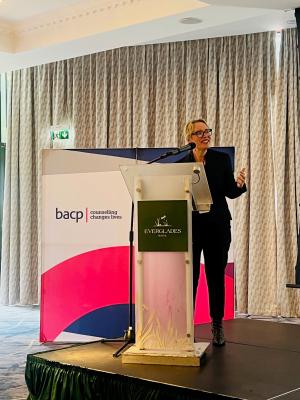
Commissioner for Survivors of Institutional Childhood Abuse, Fiona Ryan, attended the British Association for Counselling and Psychotherapy (BACP) ‘Making Connections’ event in Derry/Londonderry this week, where she delivered a keynote address “Listen to Know: Consultation on Supports and Services to Victims and Survivors of Non-Recent/Historical Institutional Child Abuse.”
The event provided a valuable opportunity to engage with practitioners from across the counselling and psychotherapy sector, share learning, and explore how insights from the Office’s consultation can support and inform therapeutic practice.
In her keynote address, the Commissioner drew on the consultation findings to highlight the long-term impact of child abuse and to reflect on the importance of services continuing to be supportive and responsive to the needs of victims and survivors.
Fiona shared some of the key mental health findings from victims and survivors:
- 68% said their mental health was poor or very poor
- 7% said their mental health was good or very good
- 73% of men reported poor mental health compared to 60% of women
- 30% said they were not able to access support for their mental wellbeing
- 21% stated they used private psychiatrists, and 45% used private therapists/counsellors in the past five years
Fiona also highlighted how insights gathered through COSICA’s work contribute to a growing evidence base, supporting practitioners to deliver effective, trauma‑informed care. By strengthening understanding of what fosters trust and engagement for victims and survivors, this work aims to complement and enhance existing practice across the sector.
This is particularly important given that survivors engage with counselling across specialist, community-based and private services, with 62% valuing specialist survivor mental health care. These insights underline the need for approaches that prioritise trust, safety and wellbeing across all settings.
The BACP Ethical Framework — with its commitment to justice, trustworthiness and prioritising wellbeing — reflects core principles shared by the Office of the Commissioner in its work.
A key theme throughout the discussion was the lasting impact of early experiences on wellbeing across the life course. This reinforces the importance of services that are mindful of barriers to trust and continue to support meaningful engagement with those accessing support.
Read our 'Consultation on Supports and Services to Victims and Survivors of Non-Recent/Historical Institutional Child Abuse' here.