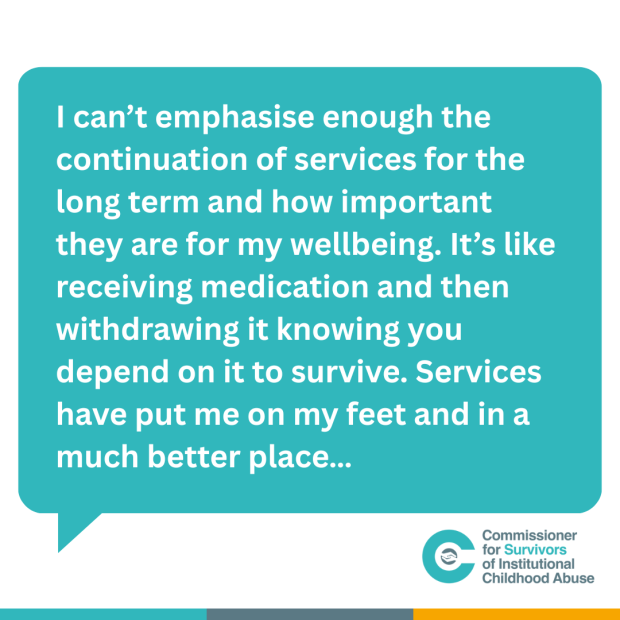
“Crucial to my state of mind is knowing specialist services will be there for the long term…”
The Office's consultation gathered the views of victims and survivors on the supports and services they need now and what they feel that might need in the future.
Read our full report here:
Why we consulted
Since December 2020, the Commissioner and her staff have engaged with approximately 1,300 individuals and dealt with over 1,700 cases. One in five victims and survivors engaging with the Office fall outside the Commissioner’s current remit.
Victims and survivors of non-recent/historical institutional child abuse have shared their childhood experiences and described how these continue to shape and impact their lives, health and relationships. They have reiterated the importance of both formal and informal supports and services available to them - from specialist provision to general health services and family and community‑based supports.
These insights informed the Commissioner’s decision to launch a consultation inviting victims and survivors to reflect on their experiences of current supports and services and what they consider they may need in the future.
The findings of the consultation provide valuable insights into the self-reported health and wellbeing of victims and survivors, their experiences of supports and services and their concerns for the future.
The results of the consultation were collated and analysed by staff in COSICA. A secondary analysis of the anonymised consultation data was completed by STRIDE, a university-based consultancy firm at Queen’s University Belfast that specialises in the design, implementation and evaluation of social impact programmes.
What we covered
- Physical health
- Mental health
- Getting medical help
- Housing
- Residential care
- Family and social needs
- Individual support needs
- Looking to the future
What we found
Of 126 responses to the consultation, 79 were men and 47 were women.
Physical Health
61% of participants said their physical health was poor or very poor.
Mental Health
68% of participants said their mental health was poor or very poor.
Getting Medical Help
90% of participants expressed discomfort seeking medical help due to their experiences of child abuse.
Housing
34% of participants reported facing housing difficulties...many survivors experienced homelessness or housing-related stress and insecurity.
Residential Care
71% of participants said they would have concerns about their wellbeing in future residential care.
Family and Social Related Needs
82% of participants told us that they maintain contact with immediate or extended family, though the quality of these relationships varies widely.
Individual Support Needs
Victims and survivors highlighted that community connections and services are crucial for combating isolation and stigma.
Looking to the Future
20% of participants told us they felt hopeful, often drawing strength from activism and support services.
Recommendations
Experiencing abuse in childhood can affect every aspect of life. The recommendations within our report are based on what victims and survivors have shared with us and reflect the ongoing impact of non-recent/historical institutional child abuse. They highlight the continuing need for trauma-informed supports, services and policies.
Northern Ireland has already made progress in embedding a trauma-informed approach into practice and policy. Our recommendations aim to:
- Build on this work using a strengths-based approach
- Provide insight to guide both immediate and long-term supports
- Ensure victims and survivors’ experiences remain at the centre of decision-making
- Raise awareness of the specific needs of victims and survivors and influence policies and practices that affect them.
Hear from the Commissioner
In this short video, the Commissioner reflects on what victims and survivors shared with us during the consultation and why their insights matter for future policy and practice.
Acknowledgements
The Commissioner and her staff would like to thank the individual victims and survivors of non-recent/historical institutional child abuse who took the time to participate in the consultation. The insights shared continue to guide our understanding of what victims and survivors need now and in the future.
We are grateful to the victim and survivor groups who promoted and engaged with their members in relation to the consultation.
We would also like to thank the Victims and Survivors Service, WAVE Trauma Centre and Advice NI for their valuable insights in developing the consultation and supporting victims and survivors to participate.
Our thanks as well to the Executive Office Victims and Survivors Directorate for their support.
Accessing this report
If you are unable to access this report digitally or would prefer to receive a printed copy, please contact us via email at info@cosica-ni.org or call 028 9054 4985 and we will be pleased to assist.